
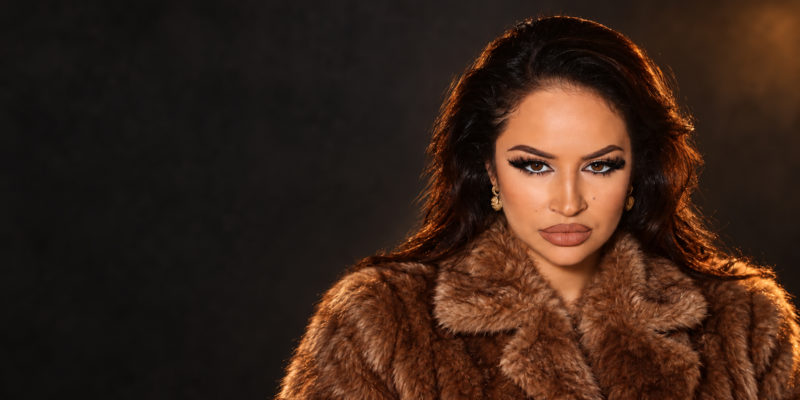
From the screen to the stage, from Australia to LA, an extensive background in acting and the arts and a deeply-rooted affinity for West Coast Hip Hop – cultural diversity naturally brings through a hardstyle sound that’s synonymous with the name. Califani’s single Straight Like Dat is making waves through the underground scene.
We caught an interview with the actor, artist and performer, to find out more about the different disciplines she upholds, the creative process for a track like this, the value of collaboration, the impact of hip hop’s darker side, and plenty more. Here’s the conversation in full.
* * *
Califani – amazing to connect, huge congrats for your success so far! To introduce things, who or what first inspired your passion for hip hop?
My earliest memory of connecting with hip-hop is sitting in the back seat of my parents’ car in Australia, hearing Tupac’s “Ghetto Gospel” on the radio. I was a little girl, rapping along to the whole song, and it touched me so deeply. I understood what he was saying, and it meant something to me. People might assume that because you’re a child, you can’t connect with something on that level, but I did. I really did.
Although it isn’t hip-hop, Madonna’s “Like a Prayer” had that same kind of effect on me. I would watch the music video on repeat and cry. The music, the story, and the visuals meant something very deep to me. That emotional connection to music was there from a young age.
And 50 Cent was our number one guy growing up—my brother and I used to listen to his albums on repeat. He was such a big part of our childhood together, so his music holds a special place for me.
I also loved Missy Elliott. When I was around seven or eight, I used to love krumping to her music. Hip-hop could reach me emotionally, but it also brought out that energy and desire to perform.
Eminem was another huge influence. His writing is incredible, and I love how much personality and emotion he puts into his delivery. With both him and Tupac, you feel the person behind the words. They could pull you into a story and hold your attention.
I also grew up listening to Ice Cube and N.W.A. I’ve always been drawn to that rawness—the confidence to say what you mean and make people feel it. All those artists connected with different sides of me, and they’re a huge part of why I fell in love with hip-hop.
Your style blends west coast hip hop influences with a hardcore delivery spanning NYC and Houston artistically. How did you stumble upon your own sound creatively, and how did you hone your abilities over time?
When I first started recording, that hardcore delivery was already there. It was 100% natural. It came from the music I grew up listening to and what drew me to hip-hop in the first place. I’m not saying that’s the only way to rap, but to me, it’s the most powerful. There’s something about that intensity that makes a message really land. You feel what someone is saying.
From there, I started experimenting with different voices and sounds. I’m versatile—I can do different accents, impersonate characters, and move between styles, so naturally I want to explore that in my music.
“I don’t want every song to sound exactly the same. Different tracks bring out different sides of me, and I think that keeps things interesting.”
But I have to give credit to my team, too. I bring my voice, personality, and instincts, but their contributions have been a huge part of making the records what they are. Without them, I probably wouldn’t have had some of those bangers.
As far as improving, a lot of that has come from simply doing the work. The more I record and experiment, the better I get at knowing what works for my voice and what I want to hear back. The natural delivery was there from the beginning; experience has given me more control over how I use it.
Straight Like Dat is an anthem, dark waves of synths and a trap rhythm backing diverse vocals and a catchy hook. What was the writing process like?
“Straight Like Dat” came together through a process that starts with real conversations. I might be in the club feeling myself, or in the car catching a vibe, and something comes to mind. I’ll call my team and say, “Record this conversation —we’re going to turn it into a record.”
My team includes Max Lux, Rick “Rich Rick” Cunningham, Eric “iShowOff” Cunningham, Kristian Kross, and Mickey. Kristian and Mickey are a big part of that writing process. They let me talk freely about my thoughts and experiences, and then we work together to shape those conversations into lyrics.
We’d get into the studio, listen back, talk through my ideas, and put the song together. That’s how we’ve been approaching the next five records as well. The starting point is always my thoughts and experiences, and the collaboration helps turn them into something you can play.
You also performed a leading role in Mob Wives Australia—how do you balance acting and music, and what’s your biggest ambition right now?
Acting and music do feel different to me. You’re stepping into different roles, and the process of completing a song is very different from completing a television episode or a film, especially in terms of time. But both require talent and delivery. You have to bring something that people can connect with.
Balancing them feels pretty natural. I show up, understand what the role or the record needs, and bring myself fully to it. I trust my instincts and let people’s reactions do the talking. I know who I am and what I bring. If it isn’t for somebody, that’s fine—it doesn’t change my belief in myself.
My biggest ambition right now is to release a song that everyone is streaming on repeat and blasting in their cars. I also want to get back into acting—it was my first passion and the first thing I pursued professionally. I love stepping into different characters, and I’m ready for a film or television role.
I’m currently in talks with producer Cassandra Cooper about potential opportunities. Nothing is confirmed yet, but I’m excited to see where those conversations lead.
When you’re recording, how do you decide which version of Califani a track needs—the storyteller, the character, or the unapologetic rapper?
The beat definitely brings out a certain side of me straight away. I’ll hear it and instinctively feel how I want to deliver the song. But I’ll still test another approach or two to see whether my first instinct is the strongest. Sometimes that confirms what I felt immediately, and sometimes I find something I like even more. I trust my instincts, but I also give myself room to experiment.
What was it like appearing on the Fitzy and Wippa Show alongside Roberta Williams—how did you connect with this project and what did it bring out in you artistically?
That opportunity came through Steven Gold, a longtime friend of mine and the producer behind the project. He loved my story and felt I was a perfect fit for Mob Wives Australia, so he cast me as one of the main girls. Through him, I also had the opportunity to appear on Fitzy and Wippa alongside Roberta Williams.
For me, this was about sharing my real life. It was reality television, so I was showing up as myself, with my own experiences and personality. That appearance introduced people to Stefani Samac—the woman behind Califani.
And that’s why I say Califani is not a gimmick. The confidence, the strength, the dominant personality—that was already me. People got to see that before they knew me through my music. I didn’t have to invent a different woman to become an artist. I brought the woman I already was.
What has the transition from Australia to Los Angeles been like in terms of the lifestyle changes and the musical influences and opportunities you’ve found?
LA opened a lot of doors for me. I’ve knocked on doors in both Australia and Los Angeles, and Australia is great, but there aren’t as many opportunities for the kind of music and entertainment career I’m pursuing. LA brought me closer to people I could create with.
But moving halfway across the world on your own, funding everything yourself, and building a life without family nearby isn’t easy. I own a corporation, and behind every achievement people see, there’s work, responsibility, and personal investment.
“In a lot of these rooms, I’m a woman playing what people traditionally consider a man’s role. I handle my business, and I expect the same respect and seriousness a man would receive.”
I don’t like any funny shit, and I don’t play games. I have boundaries, and I won’t compromise them to get ahead. I’m building this on my own terms.
Let’s talk about Max Lux—longtime friend and manager, a renowned producer and songwriter in his own right. How important has this friendship been in carving out a career and identity as an artist?
If we’re talking about Max, we have to talk about his beautiful wife, Brandi Boyd, “Lil B,” too. Anything I do with him, I do with her, and vice versa. They’re a unit. They’re a team.
People know Max for his talent and his work in music, but what he and Brandi mean to me goes much deeper than that. Moving to Los Angeles meant building a life without my parents or the people I’d grown up knowing and trusting. When you’re feeling low or need guidance, you miss having that solid, family connection—someone you can call in the middle of the night and know they’ll be there.
Max and Brandi have been those people for me. They’re like my guardian angels. They’ve guided me towards the right paths and helped steer me away from situations that could have harmed me. They’ve been there through some of my most difficult times, and that support has meant so much to me personally and as an artist. Having people who genuinely care about your wellbeing makes a difference when you’re building a life and a career so far from home.
They’re two of the realest people I’ve met in California, and I tip my hat to both of them. That’s my family. I have so much love and respect for them.
You were sadly on the scene when Nipsey Hussle was shot, and were interviewed about what you saw—how does this kind of experience impact your view of hip hop culture, and does it change the way you feel about the live scenes or the songwriting at all?
I wouldn’t say it changed my music, but it definitely made me think more deeply about myself as a rapper in the LA scene, the things I want to talk about, and the messages I want to put out. It also made me think about different ways I could help communities and make a difference.
I’ve met people from many different walks of life and found myself in situations that have shaped my perspective. But nothing takes away from how shocking and sad it is to witness something like that. It wasn’t the first time I’d seen something like it, and it still hit me.
I also don’t see violence as something exclusive to LA or hip-hop. It happens around the world, and behind every incident are real people and families.
For me, music is a place to tell a story and express things that might otherwise be difficult to say. It can give you a way to process your experiences and get a message across without turning it into a direct confrontation. That’s part of what makes music so powerful to me—you can take something you’ve lived through and give it a voice.
Given your culturally diverse heritage and experience, what’s the main value you want to bring to modern music?
Authentic storytelling, one billion percent.
“I’ve lived a very interesting life—one you could make a movie about. My heritage, the places I’ve lived, and everything I’ve been through have given me a story that’s my own.”
I’m a walking true story, and I intend to tell that story in every way I can, whether that’s through music or film. I want people to connect with the woman behind the voice and understand where that confidence, emotion, and intensity come from. There’s a life behind what you’re hearing, and I have a lot of it left to share.
Is there anything else we should know?
Something people might not know about me is that I wrote a book and a film script when I was around 11 years old—a fictional story inspired by real events. Storytelling has been part of my life for as long as I can remember.
By the time I was 17 and 18, I also had the opportunity to experience television production up close. My former manager and friend Tino worked at Hollywood Center Studios, and through him I had backstage access to productions including Basketball Wives, Disney’s Austin & Ally, and Jessie.
I was there as an invited guest, spending time on the sets, meeting cast members, and joining them during their lunch breaks. I was also allowed to sit and watch them film the episodes in person, seeing the actors and crew at work as it happened. I still have photos on set with people like Raini Rodriguez and Debby Ryan. Those were special experiences —getting to see that world beyond what everyone watches on television.
So my connection to entertainment goes back a long way.
“People are getting to know Califani now, but there’s a whole history of writing, performing, and experiences behind the woman they’re meeting. There’s still a lot of my story left to tell.”
* * *
Find Califani on Instagram. Stream Straight Like Dat on Apple. Photo credit: Vincent Egezi.