
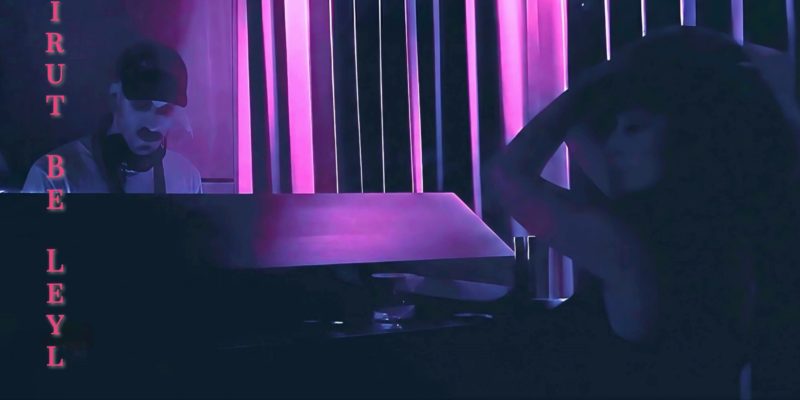
Beirut Be Leyl marks the first original collaboration between Lebanese artist Shereen Suleiman and producer, DJ and percussionist JOOL. The new single unites two distinct artistic worlds: JOOL’s underground electronic and nightlife background and Shereen’s intimate, alternative approach to Arabic songwriting and performance.
We caught an interview with songwriter and artist Shereen Suleiman, to find out more about the track and the impact of collaboration on creativity. Here’s the conversation in full.
* * *
Hi Shereen – great to re-connect with you! It’s been one year since we last spoke – how have things changed for you since the release of Ghareeb?
Yes, it will soon be exactly one year.
I remember our previous conversation, when I mentioned that Ghareeb had been a real learning experience for me. It taught me a great deal. It was a starting point.
Since then, I’ve released two more singles, Fik and Beirut Be Leyl, as well as two particularly enriching collaborations with two very talented artists. Each of these experiences has brought me something valuable.
I’ve evolved technically and vocally, but also in the way I approach music and define my musical identity. Things have become much clearer and more defined in my mind.
At the moment, I’m working on my fourth single while also developing an album project. It’s something that will take a little more time, but I hope I’ll be able to bring it to life soon.
The new single is a collaboration with DJ, percussionist and producer JOOL – how did the two of you connect, and what was the creative process like?
Beirut Be Leyl is a collaboration with JOOL, whose real name is Julian Naaman. He’s a very talented producer, percussionist and musician based in Beirut. He’s someone who truly lives for music; it’s simply part of who he is.
We met in Beirut. At first, we discovered each other through social media. I started exploring his musical universe, and he discovered mine. We gradually began exchanging ideas and getting to know each other online. Then one day, we arranged to meet at his place, where he has his own workspace and produces his music.
During that first meeting, he asked me how I usually approached songwriting. I explained that I often start with a theme, a subject, or an idea that I have in mind. From there, I work a lot through improvisation. He told me that improvisation was also an important part of his own creative process. He then suggested putting on one of his compositions and letting me improvise freely, while he would interact with me through the music, adding elements, working with the rhythm and gradually developing the composition.
I have to say, I was quite intimidated at first. I was walking into a place where I barely knew anyone. I only knew JOOL virtually, and there were several other people at his place. So there I was, having to improvise and sing over music I had never heard before, in front of people I didn’t know. It wasn’t exactly an easy situation.
He started by playing something quite simple, but beautiful. Little by little, I began to enter the musical world he was creating. It took me a little time to completely let go, but the first words that came to mind were “Be Leyl” — the night. From there, the words, ideas and melodies gradually started to take shape.
And that’s how Beirut Be Leyl was born.
What’s quite remarkable is that the track, which lasts around twelve minutes, corresponds almost entirely to the duration of our improvisation that evening. Throughout those twelve minutes, JOOL and I built the piece together, in a continuous musical dialogue.In the end, he decided to keep the entire improvisation. He barely cut or edited anything. He wanted to preserve the piece exactly as it had been created, with all its spontaneity, its evolution and even its possible imperfections.
I absolutely love his way of working. I particularly appreciate his very organic and instinctive approach to creation. That’s something that really resonates with me: allowing emotions and feelings to develop naturally, experiencing the music, nurturing it and letting it evolve without trying to control everything from the beginning. His approach is quite rare. I’m perhaps a little nostalgic about that experience because I know that not every collaboration works that way. Of course, every encounter brings something different, and every experience enriches us and helps us grow. But this very free, organic and emotional approach to the creative process has a particular value for me.
Tell us about the song title – what’s the concept and meaning behind Beirut Be Leyl?
Beirut Be Leyl is about the very particular relationship Beirut has with the night.
I spent many years in France before moving back to Lebanon a few months ago. I think coming back allowed me to look at Beirut from a slightly different perspective, particularly when it comes to its nightlife.
Beirut has always been an incredibly vibrant city at night. It’s actually an important part of its identity. We’re familiar with the Lebanese relationship with partying, music and dancing, sometimes even with a certain sense of excess. People sometimes make fun of this reputation, but I think it says something much deeper about our society.
Lebanon has gone through decades of wars and crises. Yet, even during the most difficult periods, Lebanese people have always found places and moments to sing, dance, get together and let off steam. I’ve often felt that this relationship with partying is also a way of expressing and releasing anxieties, fears and traumas that we don’t always know how to deal with in other ways.
At night, Beirut comes alive. It barely sleeps. But when I moved back, I felt something had changed. I returned shortly before the latest war, after years already marked by economic crises, the port explosion and different periods of violence. The city had been deeply wounded.
And when I went out at night, I felt something was missing. Of course, there were still people around, places were open and there was music, but I couldn’t quite find the same energy I remembered. I felt that sadness had become much more visible, almost tangible. As if the city was now carrying its wounds in a much more raw way, no longer able to hide them behind the energy and madness that had long characterised it.
“I found myself asking the same question over and over again: Where has Beirut’s soul gone? This stayed with me a lot after my return. And yet, when I started improvising with JOOL, I had absolutely no intention of writing a song about this subject.”
I think what I’m trying to express in this song goes beyond nightlife itself. For me, there’s a connection between the night in Beirut and a form of collective memory that is passed down from one generation to another. In Lebanon, we still struggle to confront our history and our collective traumas. There are very few spaces where we can engage with this process of remembrance, whether on a historical, cultural or psychological level. The civil war, for example, remains an extremely complex subject. It’s still barely addressed in school history programmes, and we have never truly undertaken a collective process of dealing with that memory. There is also a difficulty in speaking openly about our traumas, acknowledging them and passing that memory on.
I believe that, in this context, the spaces of freedom Lebanese people find at night have a particular importance. These are moments when we can let go, when constraints temporarily disappear and we can release emotions that we sometimes keep buried. There’s something deeply collective about these moments, an energy that emerges between people and that, in a way, allows us to reconnect and free ourselves.
For me, the night can be a space for healing. Ultimately, that’s what Beirut Be Leyl is really about, rather than partying or dancing as simple forms of entertainment. It’s a way of reminding ourselves that, despite all the suffering we’ve been through, despite the wars and atrocities, we need to preserve these spaces where we can come together, express ourselves and feel free.
In a way, Beirut Be Leyl is also a call not to lose that freedom. Not to lose our ability, as Lebanese people, to transform our suffering into a collective energy and to keep living despite everything.
How naturally did the electronic underground sound and the Arabic songwriting and performance nuance come together, and were there any creative hurdles to jump over, or was it smooth sailing?
I think I’ve already touched on part of this in my previous answer.
I absolutely love writing, and I particularly love singing in Lebanese Arabic. The writing often comes quite spontaneously. Words appear, and then gradually they create images, sensations and atmospheres that I try to translate into lyrics.
With JOOL, there was genuine communication through music. We responded to each other, fed off each other’s ideas, and things developed naturally in the moment. Honestly, it was very smooth.
You mentioned last time that no one track can representation the broad scope of your sound, and this new release pays tribute to that truth. Your voice has an almost jazz-like quality here, meandering through these atmospheric layers for a minimal and intimate dose of escapism laced with humanity and feeling. What did JOOL’s approach and skillset bring out in you and your performance style?
It’s true that jazz and blues have had a huge influence on the way I sing. These are musical worlds that really speak to me, particularly because of the freedom they offer in terms of interpretation.
In jazz and blues, there’s a structure, a rhythm and an initial melody, but there’s also the possibility of wandering away from them, deconstructing the rhythm and finding your way back to it. You can take unexpected paths, explore and improvise. That freedom is very important to me. It’s part of my identity and my relationship with music.
“I’m someone who needs freedom, and when I sing, I want to experience that same freedom. I like letting myself go, going further, exploring and surprising myself. I don’t want to control everything too much.”
When I sing, I don’t necessarily think about pitch accuracy or technical perfection. I’m much more instinctive and emotional in the way I approach my voice and my approach has always been more about feeling than technique.
That’s also why I loved working with JOOL. The dialogue we created allowed me to wander freely through his musical universe, explore different ways of using my voice and avoid placing limits on my interpretation. I actually think my singing in Beirut Be Leyl is quite undisciplined, in a good way. I move from one intention to another, change rhythms and let the music carry me. JOOL really allowed me to go in that direction. And I have to say, that moment of creation was almost orgasmic for me! – a real moment of musical pleasure.
That said, his music also represented a challenge for me. His sound is very dense, with very prominent bass lines and percussion. It’s not necessarily easy to place a voice and lyrics within that kind of sound without risking being swallowed up by the music itself. I had to find my place within that sound, to make my voice and lyrics exist without having to force things or shout just to be heard.
What do you hope listeners take away from the track?
That’s a very interesting question. I think this song might find its place more fully with time, perhaps a few years from now.
I also tried to extend this idea through the music video. It lasts around twelve minutes and offers a kind of dialogue between different generations of Lebanese people, from the pre-war era to the present day. It’s a way of bringing these generations into focus and exploring their relationship with the night, which has crossed different eras and become part of our collective identity.
I also think the length of the track plays an important role in how people receive it. Twelve minutes is not an easy format, either for music distribution or for watching the video. I realised that quite quickly. With my previous single, Fik, for example, which was around three minutes long, distribution was much easier. The video was easier to watch, and the format was more accessible.
Today, we’re used to consuming music and images very quickly. Everything has to move fast. Songs are getting shorter, and formats are designed to capture our attention immediately. Beirut Be Leyl deliberately goes against that trend. It asks the audience to step outside their habits, take their time and accept a different way of listening and watching. You have to want to spend twelve minutes with a piece of music and allow yourself to be carried by its evolution. So I think the audience that might connect with this song could be more limited, but it’s an audience of people who are willing to engage with a musical and visual experience that requires a certain amount of attention and patience.
I would really love for people, a few years from now, to listen to Beirut Be Leyl again and feel that it belongs to a certain Lebanese musical culture, that it bears witness to a particular era, a city and a particular relationship with music and the night.
Perhaps that’s also what I would like this song to leave behind.
What do you have planned for the remaining two months of 2026?
At the moment, I’m working on several things.
First of all, I’m preparing my next single, titled Ma Fa2r2a Ma3e, which could be translated as “I Don’t Care”.
“It’s a song about women’s liberation from male violence, told through the story of a woman coming out of an abusive relationship, both physically and psychologically.”
It’s the moment when she finds her strength again, takes back control of her life and decides that she will no longer allow herself to be defined or trapped by that violence. It’s a song about emancipation and reclaiming oneself.
I’ve finished the demo, and I’m now working on a new collaboration. I’d rather not reveal the name of the person just yet, as the project is still in development. But I really enjoy collaborating with other artists and exploring new ways of creating together.
That was already the case with Fik, which I worked on with Marc Ernest, the Lebanese pianist, and then with Beirut Be Leyl, with JOOL. This new collaboration is another opportunity for artistic encounters and experimentation.
At the same time, I’m also preparing a small concert in Beirut. It will be my first concert in the city, in a lovely venue, and it will have a rather intimate format. Since I’m just starting to perform live, I want this first experience to remain small-scale, something very organic and authentic. I’m still thinking about the format of the concert and how to incorporate the visual aspect into it. I hope to present it within the next few weeks, probably in about a month or a month and a half.
And then, on a broader level, I’m also working on creating my album. It’s a project that’s gradually taking shape and represents an important step in my musical journey.
* * *
Find Shereen Suleiman on Instagram.