

Pure creative freedom and diversity built from the need to overcome struggles and encourage better mental health. HOUNDS & JACKALS is a musical project blending sound, games, magic, and interactive media, and the artistic powerhouse has released an extensive amount of albums and videos over recent years.
Collaborating directly with other artists – vocalists, musicians, songwriters – from across the globe, HOUNDS & JACKALS has established an eclectic but stylistically well-grounded sound. The writing is unique, provocative, imaginative – often playful, always considerate – and the music follows suit in effectively standing out from the crowd.
We caught an interview with the driving force behind all things HOUNDS & JACKALS. Here’s how it went.
* * *
For those new to the name – what inspired the creation of Hounds & Jackals?
The name Hounds & Jackals comes from one of the oldest board games in human history, discovered in ancient Egypt and often referred to as The Game of Hounds and Jackals. That alone brings together mythology, fate, strategy, and play—core themes that run through everything I create.
But the name also has a very modern purpose. Dogs are central to the project both symbolically and practically.
Hounds & Jackals actively promotes mental health awareness, creativity as a healing force, and support for service dogs for people living with PTSD and ASD. In that sense, the name bridges the ancient and the contemporary, the mythic and the therapeutic, the playful and the profound.
At its heart, Hounds & Jackals is about storytelling across mediums—games, music, magic, and interactive media—working together to explore creativity and mental health in ways that are immersive, entertaining, and just a little offbeat.
Where did you grow up, are you musically trained, and how did your upbringing shape your creative approach?
I grew up in Winnipeg, Manitoba—vast, flat, and often stark. It’s the kind of place that quietly forces you inward, where imagination becomes a survival tool. When the landscape gives you very little, your inner worlds tend to grow very large.
I’m not musically trained at all, but I deeply appreciate musicians and love collaborating with them. I approach music the way a storyteller does—by building worlds and moods—then working with talented artists who can translate that vision into sound.
Why merge games, music, magic, and interactive media—and where did this journey begin?
This has been a decades-long journey. Roughly every ten years, I’ve reinvented how I create: writing and consulting for role-playing game companies, then moving into theatrical magic and mentalism, then board game design.
Just before the COVID-19 pandemic, I decided to stop compartmentalizing and simply merge everything. Music started as an immersion tool for my games—but I fell in love with the process. Producing songs, collaborating with musicians, and creating offbeat music videos quickly became just as important as any other medium.
“Music communicates emotion in ways language alone simply can’t—and that made it essential to the stories I wanted to tell.”
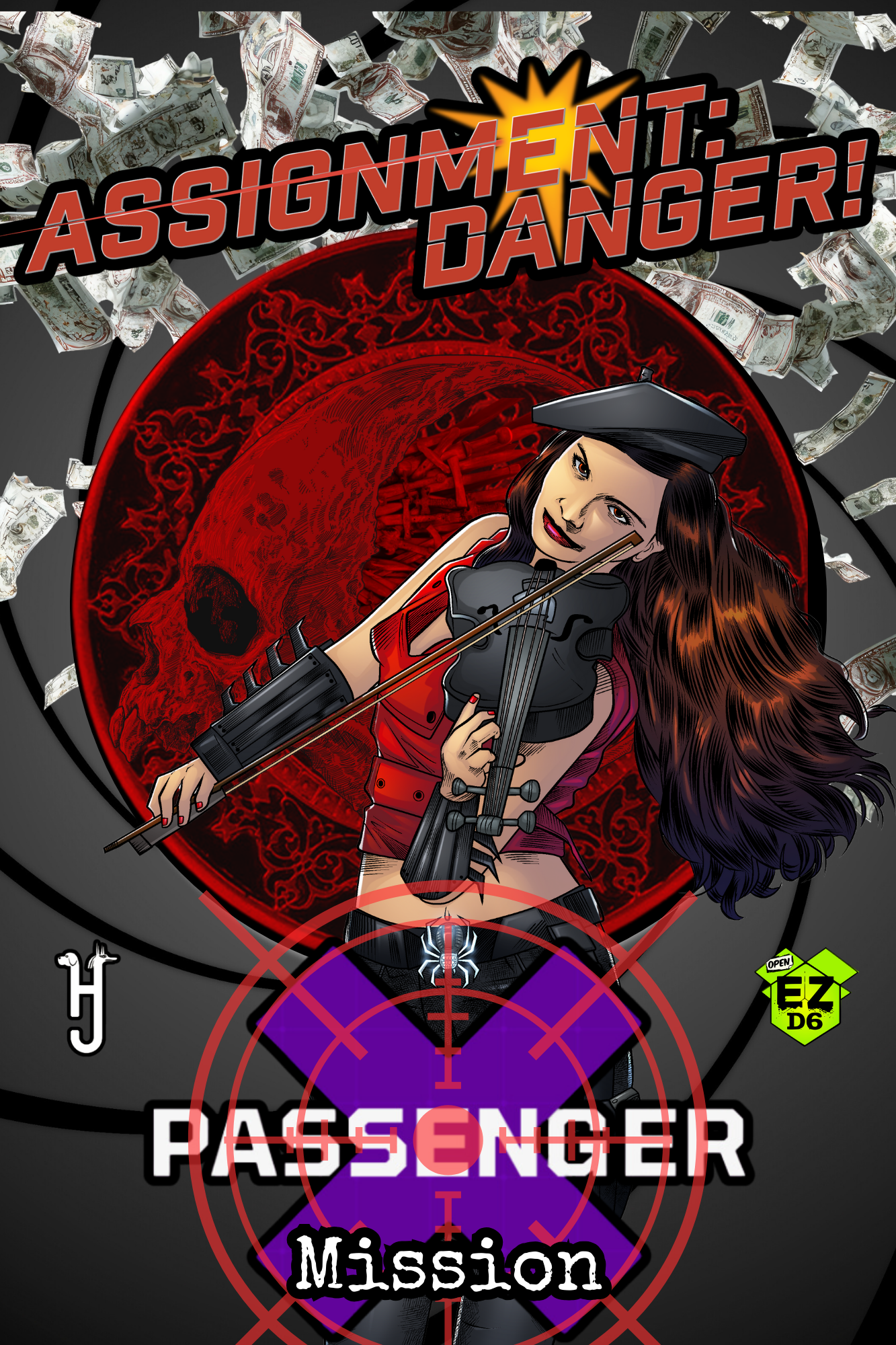
Tracks like Medusa from Assignment: Danger! blend psychedelic electronics, rock, folk, and operatic vocals. How does a song like that begin?
Everything starts with narrative. Medusa began as a villain organization—something in the lineage of SPECTRE or HYDRA. I imagined their slogans, mantras, methods, and overall identity.
From there, I think in soundtracks. For Medusa, I went straight to Lalo Schifrin—not just Mission: Impossible, but his underrated “Scorpio” theme from Dirty Harry. It has no lyrics, but like all great music, it suggests words. I could hear “Meee-duu-saaa” inside the melody.
I wrote lyrics that followed that internal rhythm, worked with a musician to create a modern sci-fi homage feel, and brought in a metal-opera vocalist to deliver it with theatrical force. Then came mixing, mastering, and building a visual world around it.
“I always work with human artists. I’m not totally anti-AI, but I am firmly against replacing the core creative act—writing, singing, performing. That’s why I also try to spotlight the artists themselves in the videos.”
What does the album title Assignment: Danger! represent, and how does it connect to mental health awareness?
It’s a direct homage to classic Mission: Impossible-style storytelling: elite agents taking on impossible missions. But beneath the surface, the scenarios explore mental health themes.
The Anvil plays with reality versus illusion inside a simulation island, evoking paranoia and disorientation. Nightfall dives into addiction, gambling, and compulsion. Across the game, I designed a mental damage system that reflects how trauma affects characters under extreme stress.
I actually helped update the Sanity system for Call of Cthulhu over 25 years ago, so this has been a long-standing interest. The goal isn’t to lecture—it’s to let players experience these themes organically, gaining empathy through play rather than instruction.
You collaborate with many vocalists. How do you choose who to work with, and do collaborations ever change direction?
I spend hours reviewing artists—often through Fiverr—before narrowing things down. I interview several, then choose the best fit. About 99% of the time, the result is exactly what I’m looking for.
That remaining 1% still produces fantastic material—it just might not fit the original project. Rather than discard it, I often save it for future releases. In fact, Assignment: Danger! generated so many strong alternate tracks that I released them as a separate album to make sure those artists were still heard (that is the album I called “Redacted”).
Some collaborators become regulars, but I always like introducing new voices. It keeps every project unpredictable and fresh.
How important is networking in a career like yours?
Absolutely essential. Everyone I work with is part of the Hounds & Jackals Pack—many are collaborators, many are friends.
As the saying goes: if you want to go fast, go alone; if you want to go far, go together. Mixing artists from different disciplines creates unexpected synergy—and often results in things none of us could have planned alone.
What tools do you use, and do you play any instruments?
I play no instruments whatsoever. That always surprises people.
What I do bring is voice work—I perform many of the character voices in the videos—and a strong narrative vision. My toolkit is intentionally simple: Canva, iMovie, Audacity, a Yeti microphone, and usually a blank notebook and pen for lyrics.
I leave musical instruments, vocals, and technical setups to the artists themselves. They know their tools better than I ever could.
What’s the single best song you’ve created?
I plead the fifth.
The albums are wildly diverse, the vocalists are extraordinary, and the musicians bring so much creativity—I genuinely can’t choose.
Your music draws heavily from classic spy films. What keeps pulling you back to that genre?
For the Assignment: Danger! albums yes. High-octane escapism. Exotic locations, dangerous villains, saving the world—and occasionally wrestling with moral gray zones. When done well, those films are endlessly rewatchable. I never get tired of them.
But I take my love of many genres to fuel the music I produce…. NEMESIS is an ode to the 1980s cartoons, TV, movies and comic books I loved… Deities and Demidogs is to world beat and mythic music… Club Styx albums will be from horror films from across the ages… it may all be niche, but I believe there are other people like me out there that may appreciate listening to these offbeat tunes and get some enjoyment from them!
You’ve released four albums—how do themes emerge, and what’s next?
Actually seven 🙂
The games always come first. The very first album, Deities and Demidogs, was music dedicated to a tarot deck designed for reading as well as magicians called the Mythodogical Deck (with the guidebook “The Gods must be Canine!”). Later on, I started to write a fantasy horror setting called Mystmoor, and I started to do some videos for the project, leading me to the start of making some music videos which grew into an entire album of songs and soundscapes. I wrote all the lyrics, and pretty much have been going strong since. Mystmoor was an actual break from my work on Assignment: Danger! spy game, and fresh of the last experience, I felt like making music for the latest adventure I was writing, Nightfall.
Nightfall started as a single song, then became a series identity. One leftover track led to Nemesis, inspired by a planar odyssey I ran for friends during COVID.
Then there was Club Styx—a haunted jazz speakeasy that kept reappearing in scenarios. People loved it so much they pushed me onto Bandcamp, and suddenly I had an album. Then I thought why not put all the music I had developed over the years on Bandcamp…. So I did!
Some albums are just experiments… such as the Nightfall album. I liked the music so much, I asked the musician to take the theme and redo it into 1-minute loops with a different mood/setting to evoke, just like John Barry would do for his Bond film soundtracks. Meaning, during the adventure there are various scenes likely to occur, so the main nightfall theme was redone into a loop that can be repeated as a background mood piece, such as being in a casino, an action scene, a mission briefing, a menacing situation, and a final climax.
Each project grows organically, often in ways I don’t expect. What happened also over time is ending up a regular cast of vocalists and musicians for the core of most albums with room to bring in new people each time, which also creates a sort of cross-album connection, in addition to a great deal of overlapped fictional world links as well.
Any plans for live performances?
Realistically, no. The artists are spread across the globe, and everything has been created remotely, with me assembling it all behind the scenes.
What’s coming in 2026?
A series of role-playing game books the music was written for. And because people loved Club Styx—and because I have a Kaiju project brewing—I’m aiming for creating another album set in a Japanese Jazz Sake Bar. Of course, instead of Tom-Who-Waits and the Bone Pickers band, you will get Dino Martin(i) and the 3-Headed Dragon Band…
What’s the best part of making independent music?
Connection. Indie spaces thrive on collaboration, experimentation, and freedom of expression. Creative people inspire other creative people—and that energy just keeps multiplying.
Anything else we should know about Hounds & Jackals?
That’s a question I ask myself regularly. Once I find out, I’ll let you know!
* * *
Find all things HOUNDS & JACKALS and download the music via Bandcamp.