
For years, artists have treated Spotify playlists as the holy grail of music promotion. They land a big editorial placement, watch streams roll in, and hope momentum follows.
The problem is that many artists are focusing on the wrong playlists.
In 2026, some of Spotify’s most powerful discovery tools are algorithm-driven, not curated by humans. Playlists like Discover Weekly, Release Radar, Radio, and Spotify Mixes help listeners find new music and often generate more long-term streams than a single editorial feature.
The good news for independent artists is that these algorithmic systems don’t care whether you’re signed to a major label. They care about signals.
The challenge is understanding what those signals are.
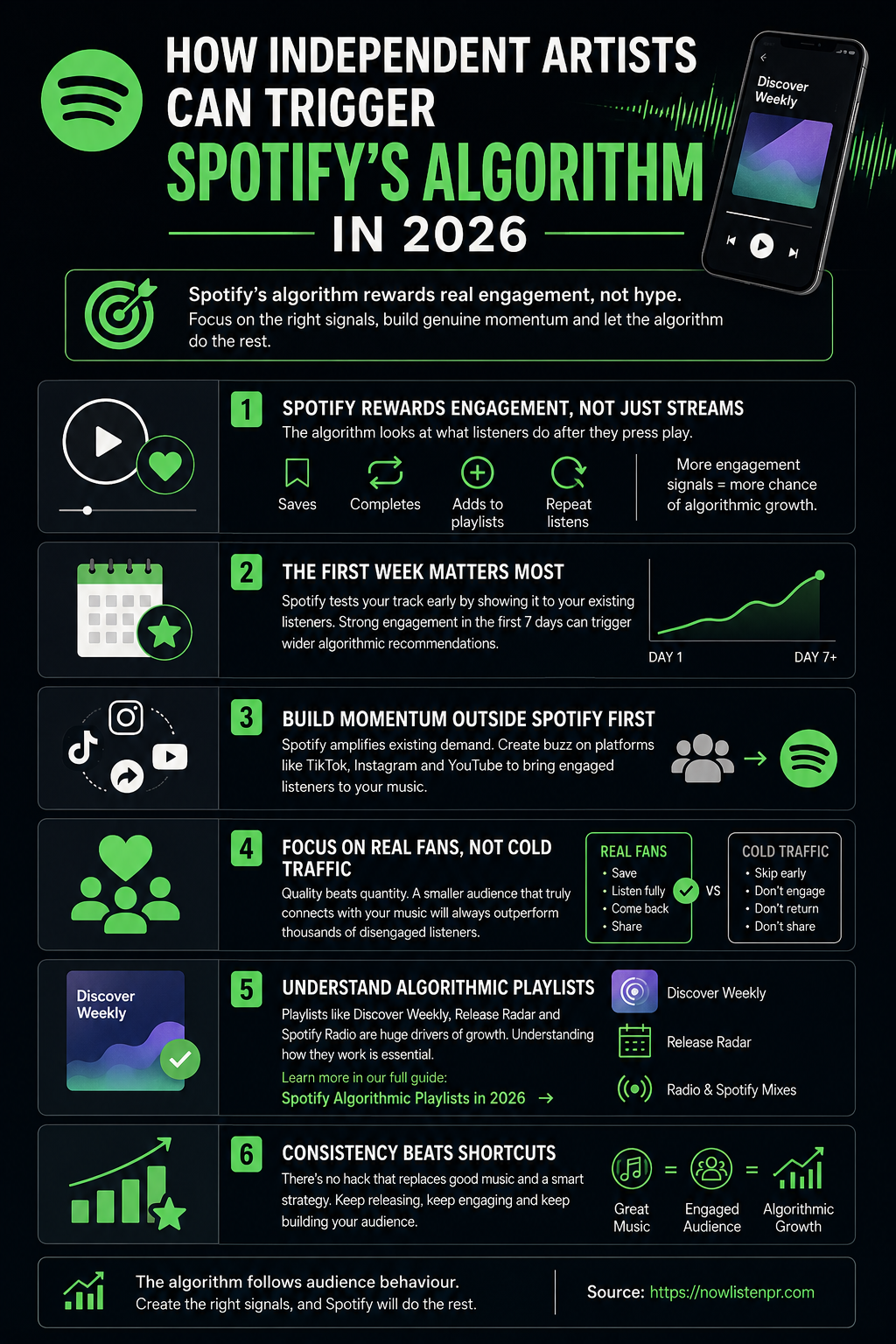
Spotify Rewards Engagement, Not Just Streams
One of the biggest misconceptions about Spotify’s algorithm is that it simply rewards songs with the most plays.
That’s only part of the picture.
Spotify tries to understand if listeners actually enjoy a track. A stream is useful data, but it cares more about what happens after someone presses play.
Do they save the song?
Do they listen all the way through?
Do they add it to a playlist?
Do they come back and play it again a few days later?
Those actions tell Spotify the track is resonating with real listeners. Often, a song with fewer streams but stronger engagement will outperform one with many passive listens.
That’s why chasing vanity numbers often backfires. The algorithm is increasingly good at identifying genuine audience behaviour.
The First Week Matters More Than Ever
Spotify pays close attention to what happens immediately after a release.
When a track launches, the platform runs a small test. It shows the music to existing followers through Release Radar and other recommendation surfaces, then watches how people respond.
Strong engagement during this early window can create a ripple effect that pushes the song into wider algorithmic recommendations.
Weak engagement tends to have the opposite effect.
This is why successful independent artists often spend weeks building anticipation before release day, instead of treating promotion as something that starts after release day.
The goal isn’t simply to generate streams. It’s to generate the right kinds of listener behaviour.
Build Momentum Outside Spotify First
One mistake many artists make is expecting Spotify to create demand.
In reality, Spotify is much better at amplifying existing demand than creating it from scratch.
If people are already talking about your music on TikTok, Instagram, YouTube, or elsewhere, those listeners eventually arrive on Spotify carrying valuable engagement signals. They save tracks, share them with friends, and return for repeat listens.
Spotify notices.
This is one reason short-form content has become so important to music discovery. It gives artists a way to generate interest before audiences ever reach a streaming platform.
The strongest Spotify campaigns often begin somewhere else entirely.
Focus on Real Fans, Not Cold Traffic
Independent artists sometimes fall into the trap of chasing large volumes of low-quality traffic.
The logic seems sound at first. More listeners should mean more algorithmic growth.
Unfortunately, Spotify isn’t measuring volume alone.
If people click a song and leave after 20 seconds, those signals can work against you. A smaller audience of genuinely interested listeners is more valuable than thousands of disengaged plays.
The artists seeing the best results tend to focus on building communities rather than collecting streams. They nurture existing listeners, encourage saves and create reasons for people to return between releases.
That approach may seem slower at first, but it is often more effective in the long run.
Understanding Algorithmic Playlists Is Becoming Essential
The reality is that algorithmic playlists now sit at the centre of Spotify’s discovery ecosystem.
Discover Weekly, Release Radar, and personalised radio stations influence listening habits on a scale few independent playlists can match. Understanding how these systems work is as important as understanding social media algorithms.
For a deeper breakdown of how Spotify’s recommendation systems operate, this guide from top music promotion company, Now Listen PR, explains how algorithmic playlists have evolved and why engagement metrics are playing an increasingly important role in music discovery.
It’s worth understanding, because these playlists often serve as a bridge between a small audience and a much larger one.
Consistency Still Beats Gaming the System
Every year there is a new trick promising to “hack” Spotify’s algorithm.
Most of them don’t last.
Spotify’s recommendation systems constantly evolve and are designed to reward behaviour reflecting genuine listener interest. That makes shortcuts hard to sustain.
The artists who consistently trigger algorithmic growth usually do something less exciting. They release strong music, build engaged audiences, and create enough momentum around each release for Spotify to notice. A collection of positive signals that build over time.
The Algorithm Follows Audience Behaviour
At its core, Spotify’s algorithm is trying to answer one question: what music should this listener hear next?
The better your music performs with real listeners, the easier it is for Spotify to answer that question.
That’s why the most effective strategy in 2026 isn’t gaming the algorithm. It’s creating the conditions that encourage genuine engagement in the first place.
The algorithm doesn’t create successful artists.
More often than not, it simply amplifies the signals that successful artists are already generating.

Your point about real engagement beating cold traffic is probably what many artists miss. If the first listeners already have a reason to care because the track genuinely fits something they enjoy, full listens, saves, and repeat plays are much more likely. That seems more durable than chasing a spike of clicks and hoping Spotify sorts it out.