
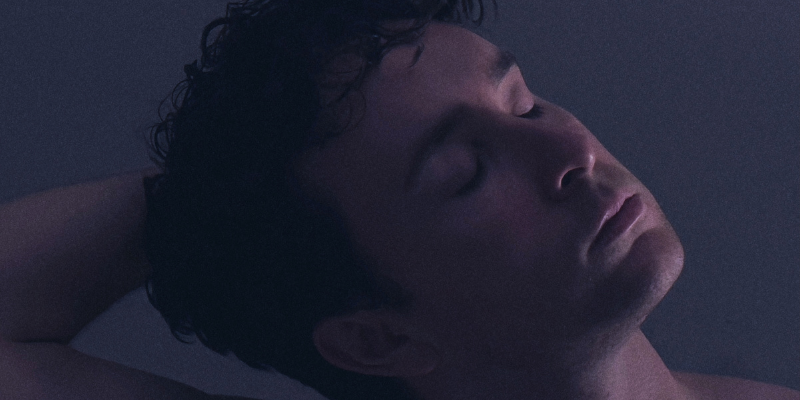
Colorado based-singer and songwriter Stephen Forster is set to release a conceptual debut project. The EP Man Deluxe features the singles Can’t Get Enough, and Hot Honey, and introduces the fictional character of Blake Wood to explore queer expression, relationships, and experiences.
We caught an interview with Stephen, to find out more about his journey as an artist, his influences, and the creative process behind this first release. Here’s the conversation in full.
* * *
Hi Stephen – great to connect with you, and my congrats for the focused new EP. To introduce things, how would you describe your sound and style as a modern artist?
It’s great to connect with you too. Thank you for having me.
My sound is generally pop and R&B-leaning, and very openly queer. A bit provocative. I would say that I pull from different genres all the time, though. I love mixing things together to create something that is unique; not just because I want something to stand out or be unique for that sake, but because I want to make something that I would want to listen to.
I also think my music has some old-school elements to it. A mix of the nostalgic and the new.
Let’s talk about the EP – ‘Man Deluxe’: where did this title come from, and what connects the songs within?
Man Deluxe was the first title that I thought of for this EP. The EP is about a fictional character I’ve created, Blake Wood, and an elevated version of himself that is used to market himself to labels. They are his musical demos, and a version of himself he curates that will sell him to a label.
What inspired you to create the character of Blake Wood, and go down the fictional storytelling route as a songwriter, rather than with the more common style of self-reflection?
I’ve always been a storyteller. I remember my parents buying our first desktop computer growing up, and I would spend hours and hours and hours just writing these little short stories for them to read. I’m sure that they were pretty terrible because I was about six or seven. But I’ve always been inclined to tell a story. I’ve written so many stories and drafts for books, films, and plays. It’s just a part of me.
“Blake, for me, is a character that contains only parts of myself, but I wouldn’t call him an alter ego by any means. I think he exists just a bit too adjacent to be called that.”
Blake became a resource for me in a lot of ways. He’s a conduit to my understanding of my own life, because whenever I struggled with something, or felt something deeply (good or bad), art always reflected it. I always consumed what I felt through different artistic mediums. And with Blake, I learned how to create what I felt in a deeper way that felt honest to me.
The first single, ‘Can’t Get Enough’, lays down an organic groove, with a riding bassline and light keys. Your vocals are lush. How do you set these tracks up – with a full band, full production, or are you a multi-instrumentalist?
I only know a bit of piano. I was a music student in school, so I have some music theory knowledge. I would love to go back and learn more and more. But, I’m a singer and songwriter first and foremost, so most of my songs start with a lyric and a melody. I usually build songs from the ground up. I have never really worried about being an incredible multi-instrumentalist because I like the idea that all of my songs can be played around a piano or a guitar with just a singer.
When it comes to getting songs done, I do consider myself a full-bodied producer. I will pull out every means necessary to get a song done. I will hire anyone and anybody who would want to work on it and who feels passionate about it.
Then for ‘Hot Honey’, we get those hi-hats and the lightness again, the intimacy and romance, the passion. Is there a chronological story to the project, and if so, what can we expect from the rest of the EP conceptually?
For Man Deluxe, there isn’t a story being woven throughout the tracks. It puts the footing underneath the idea of Blake as a character, some of the things about him that will see more light when the trilogy commences. “Hot Honey” is one of the more explicit tracks I’ve written for Blake’s story. It’s definitely explicit, but there’s also so much vulnerability and honesty if you look a bit harder. I think that it’s important to live in our truth as artists—and as gay men—in a way that doesn’t make our existence palatable. I’ve seen this more and more in recent years in so many different mediums.
The project that follows, the trilogy, is about identity, sexuality, love, and the struggle to maintain all authenticity and freedom when life pulls those three things in separate directions. It’s about the instability of becoming, and how Blake rebuilds himself after being commodified and consumed by everything around him.
You’ve mentioned that you’d like to transform your music into film – there’s talk of a three-part saga – how would you conceptualise this, and have you set that process in motion yet?
Right now, it’s just the music. I’ve been producing the music for the trilogy for years. It started as two albums before I transitioned to two longer studio releases (I think we could call them EPs?) and a full album. I decided in early 2022 to split it into three separate pieces so that I could focus on the craftsmanship of the work and to tighten the story and music that is woven throughout all three. Man Deluxe has a song written in 2020. Some of the music I have for the trilogy was written in 2019!
The story is told through impressionistic, subtextual storytelling. The trilogy should not be taken for face value. The songs convey the narrative, but there are still pieces missing that will, hopefully, be translated visually.
I began fully recording the trilogy in 2023. I recorded some music with a few other producers who I didn’t mesh well with. And I was way too sheepish to correct any of them. Haha! So I decided to go my own way and learn how to fully produce, engineer, and edit my own music. I sat for hours and hours, days on end, learning how to program synth and drum machines, do my own arrangement, and learn how to engineer. Even my earlier releases sound so different in such a short span of time because of how differently my engineering has become.
“The Feeling”, which was released in August of 2024, is the penultimate track of the first part of the trilogy. It’s a core track for the entire story. I’m happy to have released it—but I’ve redone the song entirely for the trilogy. It is such a majestic, sprawling track. My sister, Jamie, told me that a near-eight minute track was unnecessary; but she listened to it, and it made her cry.
To sum it up, yes—everything is well under way!
In terms of topical issues and societal shifts, how important is it for you to reinforce the presence of queer art and music as we approach 2026?
I think it is essential to hear from queer people. We’re so visible, and we’re making so much progress everyday, but we’re still shoed into corners of the media that leaves certain audiences out.
We’re in prestige television, niche indie films, fashion and nightlife, music, and so much more. There are many places we’re already welcomed, but that doesn’t always translate to widespread representation.
I think society needs more queer artists to take the center stage in a larger way. I think queer artists, and really any artist who has struggled as a minority, have a really unique way of coping with those struggles that are translated into their art. And I think that is what makes us bold and daring, and how we push ourselves out of our comfort zone. I think people need to be out of their comfort zone to grow—including the audience. Wherever I fit into this narrative, I’ll take it.
Given the nostalgic sound of your music, who were your first and most impactful influences?
I remember the music my parents listened to growing up. I heard a lot of Elton John, Billy Joel, and the Beatles growing up. I’m really grateful for that, because I think of someone like Elton John a lot when I was deciding how to approach my music. He just took so many sounds and threw them together. He’s a genius.
I do pull a lot from the 90s and 2000s, though. I am in awe of Mariah Carey as a songwriter and producer, and how she was so instrumental in bridging the gap between hip-hop and pop music. Butterfly is one of my favorite albums. I also love Beyoncé; I think she’s the blueprint for how an artist should evolve through their career.
The first album I ever bought with my own money was The Fame Monster by Lady Gaga. I have always been a Little Monster. I remember that, in my little corner of the world, she was not well-liked because of how avant-garde she was. I played The Fame Monster so much that “Speechless” started to skip on the CD when we went on a road trip. But she had the nerve and gall to be open and challenging, and then she had the incredible talent to back that up.
I will also say—my favorite album of all time is Melodrama by Lorde. That album was the one I listened to and I decided I wanted to make music. The production is monumental, and the songwriting is genius. I hear something new each time.
What’s the live scene like for solo artists and queer music in Colorado, and do you plan to take this project on the road?
I would love to tour and go live. It is a dream of mine to tour.
In Western Colorado, there are a ton of live musicians who play small shows. Almost year-round. And queer artists are up and coming. I would love to start doing shows, find a live band to perform my music with me live, and just grow. Touring would be such a dream come true for me.
Like many musicians, you found a significant artistic flow during the covid lockdowns. How different is the experience now, when the world continues at pace, while you’re immersed in the studio and creative setting?
I think the experience is still pretty similar, actually. I’m always writing melodies and one-line lyrics down, pulling different pieces of ideas from so many different notebooks to finish tracks. I still think about things the same way. I actually find myself more creative in the studio when I’m able to record and layer and edit and rework for hours on end. I don’t get tired of it. I can’t get enough (pun intended! Haha!).
What’s something about you that might surprise your fans?
I’ve been so preachy about consuming media—but getting me to finish a television show is like pulling teeth. Haha! There’s only a handful I’m fully invested in, like Stranger Things and The White Lotus.
Is there anything else we should know?
“That I’m very excited about what I’m doing, and proud of what I’m building. It all comes from a real place; it is some of my most confident music, my most personal, and my most fun.”
And I hope that people tune in and hear the growth with each release. And, most importantly, I hope people—queer or not—hear a bit of themselves within it.
Find Stephen Forster on Instagram or visit his Website.