
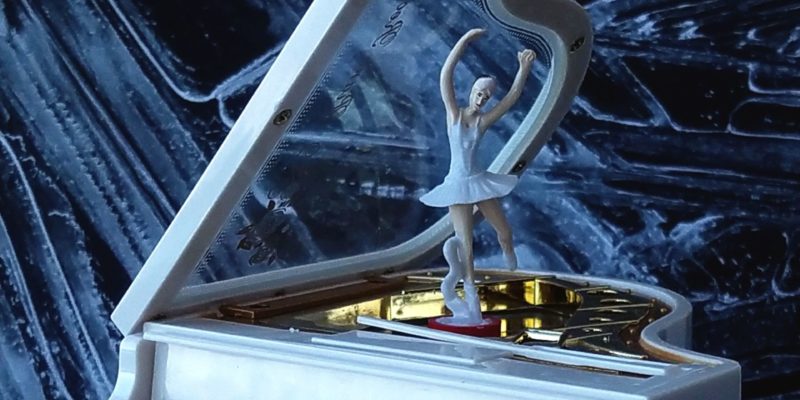
There is a particular kind of hush that descends when you lift the lid of a ballerina music box. The clasp gives with a soft click, the first few bright notes rise into the room, and a small dancer begins to turn before a mirror no bigger than your palm. The whole thing lasts perhaps thirty seconds before you wind it again, yet something in that moment feels genuinely significant, not trivial, not merely cute.
People who have not thought about a music box in decades will recognise the scene instantly, because it belongs to a shared imaginative world that cuts across generations. How did that happen? How did a wind-up figurine on a lacquered wooden box come to carry so much feeling, nostalgia, tenderness, a faint ache for things already past, simply by turning in a slow circle?
The answer runs through Swiss watchmakers and German inventors, through the prestige of nineteenth-century ballet, through countless film scenes and at least one international pop hit, and through the private rituals of children who kept their first treasures under a dancer’s revolving feet. This article traces that full arc: the mechanical roots of the music box, the rise of the twirling ballerina as the dominant motif, the symbolism she has accumulated over time, her life on screen and in song, her role as a keeper of family memory, and the ways contemporary makers, including the curated ballerina collection and custom ballerina music box designs at Only One Music Box, continue and reinterpret that living tradition.
The Ballerina Music Box: How a Wind-Up Dancer Became One of Music’s Most Enduring Symbols
From clockwork curiosity to twirling ballerina
The music box as a precise instrument began with Swiss watchmakers who took the logic of the carillon, a tower instrument whose bells are struck by mechanical hammers, and compressed it to pocket size. The key innovation was the musical comb: a metal strip with tuned teeth that produced clear, sustained notes when tiny pins on a rotating cylinder plucked them in sequence. What had once filled a bell tower could now sit in a waistcoat pocket, and these early pieces were luxury objects, owned by adults and priced accordingly.
Manufacturing advances in the late nineteenth and early twentieth centuries changed who could afford one. Costs fell, production scaled up, and the music box moved from the drawing-room cabinet into the nursery. As it did, makers began adding small rotating figurines powered by the same spring, turning the box into a miniature stage rather than a mere sound-producing device. The object had become theatrical.
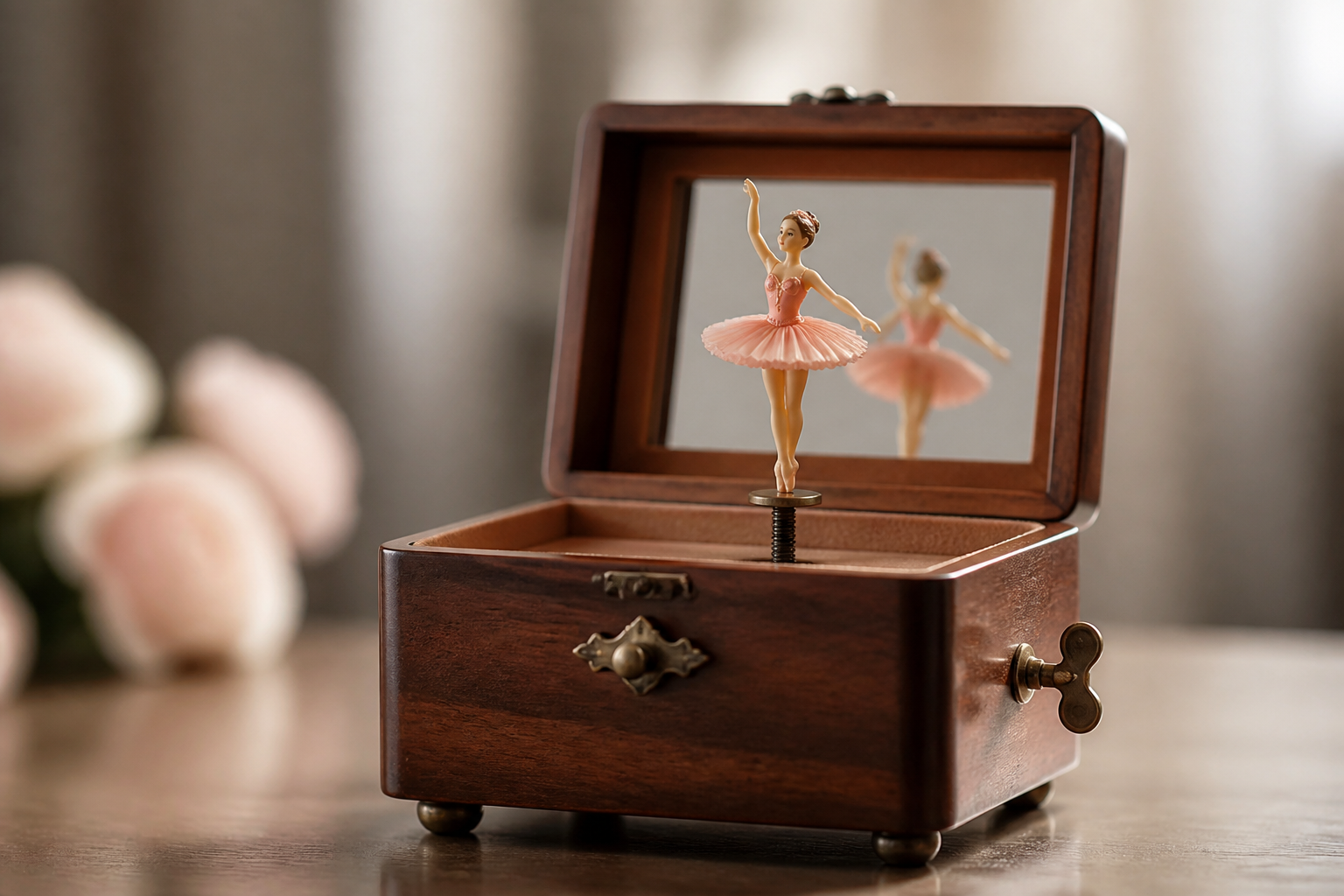
Among the figurines that appeared, the dancer emerged as the dominant choice, and the logic is easy to follow. Ballet in the nineteenth century carried enormous cultural prestige; its vocabulary of grace and controlled movement was widely understood as a signal of refinement. A pirouette on a small plinth was also, practically speaking, the ideal motion for a clockwork figurine: continuous, circular, self-contained, matching the repeating loop of the mechanism beneath. The visual grammar that became canonical, a dancer in a tutu and pointe shoes, often in pink or white, spinning before an oval mirror, still shapes what most people picture as a ballerina music box, a design language you’ll find echoed in contemporary collections, including the range at Only One Music Box, where that classical imagery sits alongside newer interpretations of the same tradition.
What the ballerina on the music box has come to symbolise
Part of the ballerina’s staying power as a motif is the precision of what she represents. The dancer appears effortless, balanced, serene, moving with an economy that looks natural, yet that apparent effortlessness is itself a kind of illusion, the product of years of discipline, repetition and physical strain. The figure on the music box captures the illusion without the strain, which is perhaps why she pairs so naturally with the equally perfect, equally illusory simplicity of a clockwork melody. Both the dancer and the tune seem to say: nothing is hard here, everything is graceful.
There is a productive tension in that image, though. The ballerina is both delicate and disciplined, both a child’s dream and a demanding reality. For many children, the spinning figure represents something they aspire to: performance, creativity, the possibility of transformation, or simply the idea of growing into a more capable self. She stands alongside a first necklace or a folded note as an emblem of a life beginning to be curated and kept, so the box does double duty, serving as a container for literal small treasures and for imagined futures.
The symbolism is also gendered, and some modern designers have begun to acknowledge that openly. The ballerina has long been associated with a particular, fairly constrained version of femininity: graceful, self-contained, performing for an implied audience. Some contemporary music box designs address this by placing the dancer in different poses, different costumes, or alongside imagery, stars, animals, abstract patterns, that shifts the emotional register away from the purely decorative. The result is that the figure can now signal strength and individuality as readily as conventional poise. The musical choices reinforce this: a box playing a lullaby speaks to innocence, while one playing a film theme or a popular melody tilts the same figure towards a quite different kind of sentiment, keeping the symbol alive by letting it mean more than one thing.
On screen and in song: the ballerina music box as emotional shorthand
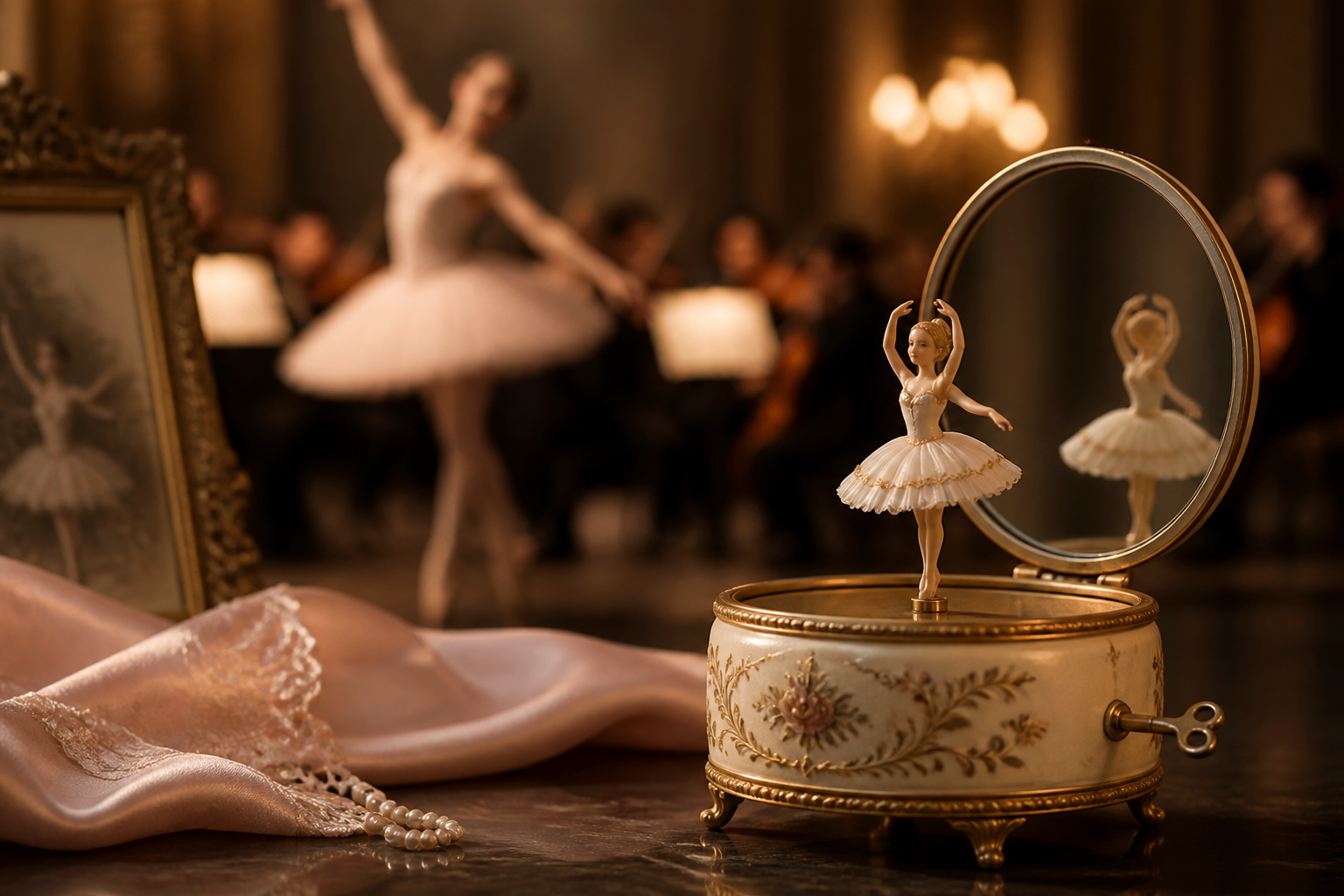
Storytellers have understood the music box dancer’s power as a signal for a long time. In film and television, a box opened in a child’s bedroom or on a dressing table is one of the most efficient devices available for collapsing time: a character hears the first few notes and is instantly returned to an earlier self, a lost parent, a house they no longer live in. The fragile, repeating tune does the work that several minutes of exposition might otherwise require, serving as shorthand for everything a person has loved and lost, delivered in the time it takes a spring to unwind.
Thrillers and darker dramas have learned to exploit the same association in reverse. Because audiences connect the tinkling melody with safety and home, hearing it echo in an empty room, or finding a box still playing after something terrible has happened, produces an unsettling contrast. The innocence of the sound is precisely what makes it disturbing in the wrong context, so the motif works both ways: as comfort and as its own negation.
In popular music, the imagery has found a different kind of life. In 1979, Canadian musician Frank Mills released an instrumental piece called Music Box Dancer that became an international hit, later given lyrics when Ray Conniff covered it, cementing the music-box dancer as a recognisable figure in collective musical memory. References in song titles and lyrics have continued since, often drawing on the idea of someone turning in the same circle, repeating a pattern they cannot escape: the dancer as both enchanting and trapped. By the time a real ballerina music box turns up on a collector’s shelf, it carries all of these layers with it. Looking at one today, especially through a thoughtfully curated collection like the one at Only One Music Box, means seeing not just a pretty object but a dense archive of other people’s stories, pressed small and set spinning.
On screen and in song: the ballerina music box as emotional shorthand
Heirlooms in miniature: how these boxes hold rites of passage
Most people who feel strongly about music boxes received their first one at a threshold: a birthday that felt different from the ones before, a first dance recital, the start of school, a bedroom that was newly and properly theirs. The box arrives at the moment when a child is beginning to have a self to curate, which is part of why the object matters. It is both a gift and a kind of permission to start keeping things.
The practical role is part of it. A small jewellery box with a latch gives a child a first experience of owning something that holds other precious things: a necklace, a friendship bracelet, a ticket stub, a ribbon from a bouquet. Placing those objects inside, winding the mechanism, listening for thirty seconds before closing the lid again, this becomes a ritual, repeated over months and years, and rituals are how meaning accumulates. The box stops being a gift fairly quickly and becomes a record.
The intergenerational dimension adds another layer. Boxes are passed down, sometimes directly, a grandmother’s box given to a grandchild, and sometimes more loosely, through the choice to buy a new box that echoes a design a parent remembers. The specific tune, the colour of the lining, the style of the dancer: these details can create a quiet continuity across families even as people move and circumstances change. If you can recall a box that belonged to someone else, on a relative’s dressing table perhaps, visible but not quite touchable, you will probably find that you can still hear it. The imagined sound is very precise. That precision, the ability of a tiny mechanism to lodge so specifically in memory and to surface decades later essentially intact, is where the ballerina music box earns its real emotional weight. The mechanism repeats, but the meaning deepens with every owner who winds it.
Choosing a modern ballerina music box as part of a living tradition
The contemporary market for dancing-figure music boxes has moved well beyond the single canonical design, though that design remains popular precisely because its familiarity is part of its appeal. Today’s makers work in a wider range of materials, different woods and finishes, crystal and glass lids, silhouette motifs rather than full three-dimensional figurines, and the dancer herself appears in postures and contexts that earlier versions never explored. She shares the lid with stars, animals and botanical imagery; she appears in colourways that sit as comfortably on an adult’s desk as in a child’s room. The object has grown up alongside the people who grew up with it.
The choice of tune matters at least as much as the visual design. A box playing the Swan Lake theme or the Dance of the Sugar Plum Fairy leans into the romantic ballet tradition that produced the dancer motif in the first place. One playing a film score or a contemporary song brings that same spinning figure into different emotional territory, more personal, less archetypal, more likely to mean something specific to a particular recipient rather than something generally recognisable. The melody, in other words, is not an afterthought; it is half the meaning.
Only One Music Box’s ballerina collection reflects this spectrum, ranging from pieces that honour the archetypal pink-and-mirror childhood box to more restrained or whimsical interpretations for different tastes and different stories. Browsing it is a useful way to feel the full range of what the tradition currently holds. If you are considering a purchase, for yourself, for someone beginning a new chapter, or for a child who has just started to notice that some things are worth keeping, the most useful question is not simply which one is prettiest, but something closer to: what kind of dancer, what melody, what atmosphere do you want this small stage to carry forward? The mechanism will repeat. What it repeats should be chosen with care.